Blog
California passes ban on all plastic shopping bags at grocery stores

Last week, I wrote about New Jersey’s effort to protect the environment by banning plastic silverware in fast food restaurants. Like plastic silverware, plastic shopping bags are also overrunning our landfills. We get plastic bags at hardware, grocery and convenience stores. Some of the bags are thick, while others are pretty thin and tear easily.
The bags with more heft are recyclable. Festival Foods, for example, uses their old bags to make park benches for weary shoppers. Many environmentally conscious consumers look for businesses that are eco-friendly. Some retailers, however, bank on this and purport to be green when they actually aren’t.
California recently took steps to curb this practice. Last year, State Attorney General Rob Bonta sued Novolex Holdings, Inteplast Group and Mettler Packaging, alleging the plastic-bag manufacturers falsely claimed their products were recyclable. The suit asserts the companies violated a state law passed in 2014 that banned plastic bags at grocery store checkouts that weren’t recyclable.
Under the law, shoppers could elect to pay 10 cents for thicker plastic bags that needed to be reusable and recyclable. The lawsuit alleges the makers of the bags labeled them as recyclable even though they were not. As a result, Bonta contends recycling facilities cannot process them and they end up dumped in landfills, incinerated, or in the state’s waterways.
“In California, we’re making it clear,” he said at a news conference. “Truth matters. Public trust matters. Environmental protection matters.”
As he announced the lawsuit, Bonta also revealed that California reached settlements with four other plastic bag manufacturers, Revolution Sustainable Solutions, Metro Poly, PreZero US Packaging and Advance Polybag, that also allegedly violated the 2014 law. The companies agreed to collectively pay the state nearly $1.8 million and halt plastic bag sales in California after selling the rest of their existing stock.
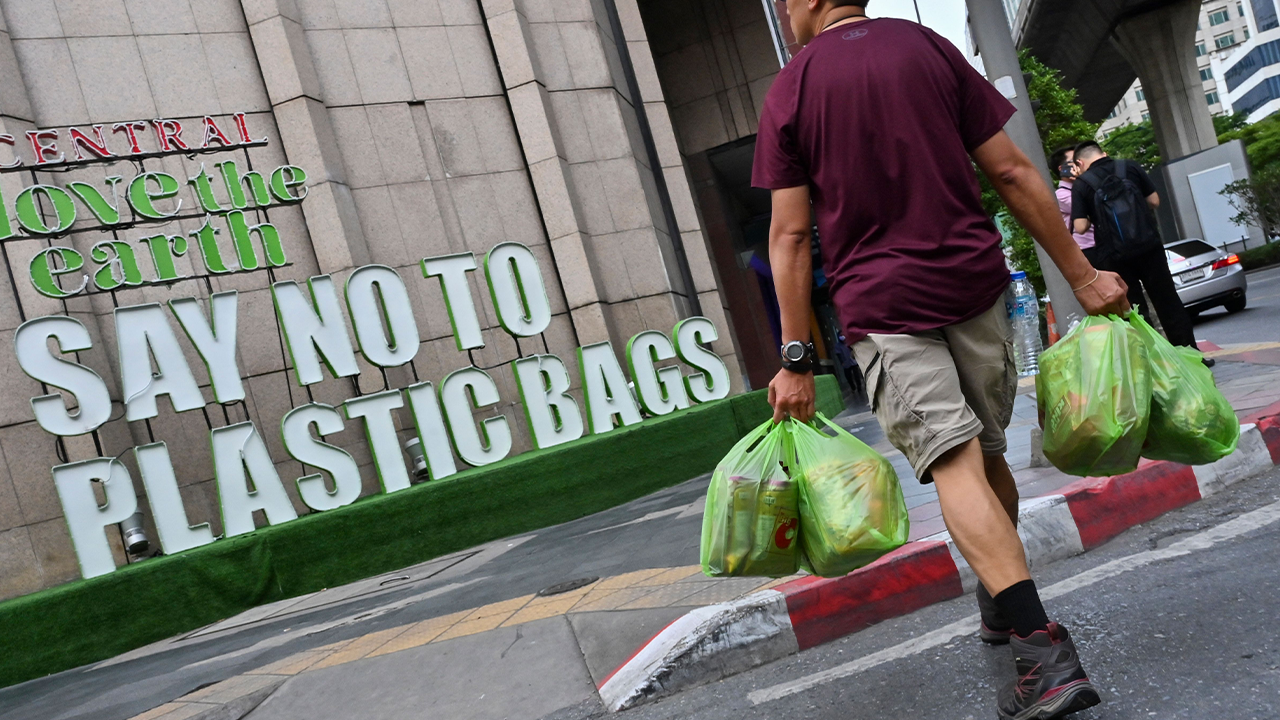
It’s unlikely that there will be very many more of these lawsuits going forward, as California lawmakers passed a law last year that will ban all plastic shopping bags at grocery stores starting in 2026. According to the environmental advocacy group Environment America Research and Policy Center, California has become the latest of a dozen states to have some type of statewide plastic bag ban, joining Colorado, Connecticut, Delaware, Hawaii, Maine, New Jersey, New York, Oregon, Rhode Island, Vermont, and Washington. More than 500 other cities and towns across the country also have bans or fees on plastic bags.
The Environment America Research and Policy Center also reports that bans in the states of New Jersey and Vermont, along with those in the cities of Philadelphia, Santa Barbara and Portland, Oregon, covering more than 12 million people combined, have cut single-use plastic bag consumption by about 6 billion bags per year. That’s enough bags to circle the earth 42 times.
According to the organization’s website, if Wisconsin, a state of almost 6 million people, implemented a similar ban, it would result in approximately 1.75 billion fewer single-use plastic bags, saving the almost 8.8 million gallons of oil needed to produce them. That number of bags would stretch 302,812 miles laid side to side and circle the earth over 12 times.
Last year, California filed a similar lawsuit against ExxonMobil, the world’s largest producer of polymers used to make single-use plastics, accusing the oil juggernaut of deceiving the public by falsely promising that its plastic products would be recycled. In turn, this caused consumers to purchase and use more single-use plastic than they otherwise would have.
While a plastic bag ban would be good for the environment, I wonder what my neighbors will use when they take their dogs for a walk.
Reg Wydeven is a partner with the Appleton-based law firm of McCarty Law LLP. He can be reached at pcbusiness@postcrescent.com.